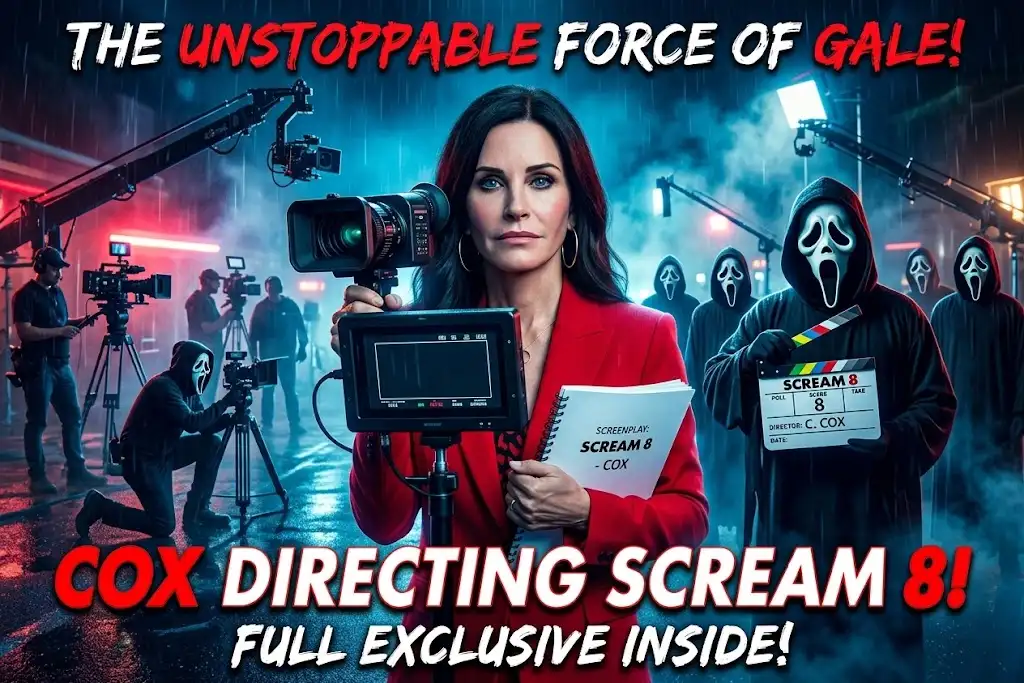
Why Having Courteney Cox Direct Scream 8 Is Pure Genius
Courteney Cox direct Scream 8? It sounded like off-the-cuff festival banter when the quote first popped onto Deadline’s feed, but anyone paying attention to Hollywood’s current horror crisis knows it is the sharpest creative instinct this blood-soaked series has seen in years.
Sitting in Toronto this September to support her sophomore feature, Cox did not hedge. She did not give the practiced, PR-cleansed non-answer actors usually lean on when asked about sequels. Asked directly if she would step behind the camera for the next chapter, she smiled and laid her cards on the table: “I think I should, honestly. Nobody knows more about that movie than I do. I mean, and the creator, and Wes Craven, and the writers, and everybody who’s been in it, but I think it’d be great and fun and a good publicity thing. Get on it.”
She is right. She is entirely right.
Hollywood spent decades treating legacy slasher sequels like disposable cash grabs. You hire a music video director, throw thirty gallons of synthetic blood at an abandoned soundstage, and count the box office receipts over opening weekend. But this series was built on subverting industry laziness. Thirty years after Wes Craven transformed a suburban driveway into an opera of modern paranoia, the series finds itself standing at a dangerous intersection of fatigue and corporate hesitation. Handing the keys over to the only performer who has survived every single slaughter since 1996 is not just clever marketing. It might be the only way to save the story.
The Real Reason Courteney Cox Direct Scream 8 Buzz Is Shaking Hollywood
The timing of Cox’s comments matters just as much as the content. We are barely seven months removed from February 27, 2026, when the seventh installment hit theaters across the country. That film brought back franchise architect Kevin Williamson to sit in the director’s chair after Christopher Landon exited the project. Financially, the project held its ground, hauling in $213 million globally against a production budget in the $45 million range.
Yet creative sentiment tells a different story.
Fans and critics walked away from the Kevin Williamson Scream 7 release feeling an unmistakable sense of repetition. Williamson delivered competence, but competence is never what made Woodsboro electric. The film played like an anxious tribute band playing the hits under low house lights. Williamson himself acknowledged the reality shortly after the box office tallies solidified, telling interviewers he intends to step back into a producer seat to focus on television projects and an unproduced original thriller he wrote years ago.
That leaves the director’s chair wide open.
Right now, screenwriting duo Lilla and Nora Zuckerman are hammering out the script for the next outing. They are working from core ideas pitched during early development sessions with Neve Campbell. That means the blueprint for the story is actively forming on whiteboards in Los Angeles while you read this. When an empty chair sits next to an active script, studios listen to public sentiment.
If Spyglass Media Group and Paramount want someone who understands the exact tonal balance of dark satire, brutal pacing, and tabloid cynicism, their search should stop immediately. Searching for a typical Scream 8 director on the commercial circuit makes zero sense when the ultimate authority on Woodsboro lore is already on the payroll.
Why Having Courteney Cox Direct Scream 8 Solves the Slasher Formula
Consider the math. Since December 1996, the Ghostface horror franchise has cycled through four distinct eras, survived the tragic death of Wes Craven, weathered studio bankruptcies, and rebooted itself twice.
Through every frame of that thirty-year run, exactly one actor has shown up on every call sheet: Courteney Cox.
David Arquette’s Dewey Riley met his tragic end via twin hunting knives in 2022. Neve Campbell sat out the sixth installment during a well-publicized salary dispute before returning for the seventh. Roger L. Jackson has voiced the killer from sound booths across North America, but Cox is the singular face physically present for every crime scene. She walked the soundstages in Santa Rosa in 1996. She ran through the Ohio college campus in 1997. She survived the fake sets of Stab 3 in 2000, the high school bloodbath of 2011, the brownstone slaughter in New York City in 2023, and the suburban siege earlier this year.
Nobody else possesses that institutional memory.
More importantly, her on-screen alter ego, Gale Weathers, is literally defined by narrative control. Gale never waited for permission from police chiefs or network executives to tell a story. She kicked down doors, hid wireless video cameras inside smoke detectors, wrote national bestsellers, and forced the entire culture to look at the carnage through her lens.
There is an eerie, poetic justice in letting Cox do behind the camera what Gale spent three decades doing in front of it.
Gale understood that media shapes violence, and violence shapes media. When you watch Cox deliver lines about sensationalism and survivor guilt, you are listening to thirty years of American culture wrestling with its own appetite for bloodshed. A director with that personal history does not need to guess how a scene should feel. She lived it.
How Letting Courteney Cox Direct Scream 8 Honors Wes Craven’s Legacy
Skeptics love to pretend that actors who transition to the director’s chair are simply indulging vanity. Those skeptics clearly do not know Cox’s actual career trajectory.
Cox directed her first narrative short, The Monday Before Thanksgiving, all the way back in 2008. By 2012, she was directing multiple episodes of Cougar Town, eventually helming 12 installments of the comedy series. Comedy direction on a tight network schedule is brutal training. It requires ruthless efficiency with camera setups, an instinct for comedic timing down to the tenth of a second, and an ability to protect performances when daylight is burning.
In 2014, she made her feature directorial debut with Just Before I Go, an offbeat dramedy starring Seann William Scott and Olivia Thirlby. That film demonstrated an eye for human brokenness that surprised critics who only knew her from Central Perk.
Then came Toronto.
The entire reason Cox was speaking to Deadline in the first place was the Evil Genius TIFF premiere. Her sophomore feature is not a lightweight indie. It is an intense, unsparing true-crime drama centered on the bizarre 2003 Erie, Pennsylvania pizza bomber case. Working with a cast that includes Patricia Arquette, David Harbour, Ryan Eggold, and Owen Teague, Cox constructed a gritty narrative about deception, desperation, and the thin boundary separating victims from villains.
Early reactions out of Toronto singled out Cox’s command of pacing and tone. She refused to romanticize the perpetrators, opting instead for cold, procedural tension punctuated by sudden emotional jolts.
If that skill set does not scream Wes Craven, nothing does.
Craven was never an exploitation filmmaker. He held a master’s degree in philosophy and writing from Johns Hopkins University. He approached violence with psychological weight, treating fear not as a cheap parlor trick, but as a mirror held up to human vulnerability. Cox spent fifteen years studying Craven’s methods up close across four distinct productions. She watched how he positioned cameras to maximize claustrophobia. She saw how he used dark humor as a pressure valve to make the next jump scare hit twice as hard.
A journeyman music video director cannot replicate that mentorship. Cox absorbed it through osmosis.
The New Blood: Tatum’s Aftermath and Generational Scars
A franchise cannot live on nostalgia alone. If the next film simply repeats the greatest hits of the 1990s, audiences will tune out.
Fortunately, the narrative seeds planted in the seventh chapter offer rich ground for a director who understands character dynamics. Speaking shortly after Cox’s comments made waves, Isabel May dropped intriguing hints about her character, Tatum, the daughter of Sidney Prescott. May survived the February release, but her character walked out of the climax carrying severe psychological damage.
“You have to grieve and mourn and miss the people that you loved forever, and now question everyone in your life forever, too,” May explained when discussing the story’s direction. “It’s a generational curse that’s just been handed down to her.”
May admitted she has an “itty-bitty, little pinky toe” involved in early story outlines with the Zuckerman sisters. That generational trauma is precisely where a director with Cox’s sensibilities can thrive.
Think about the dynamic. Gale Weathers watched an entire generation of friends die around her. She lost Dewey. She watched Sidney retreat behind fortress walls in the Pacific Northwest. If Gale is now interacting with Tatum, she is looking at a girl who has just inherited the exact nightmare Gale survived for thirty years.
Cox knows how to direct actors through grief because she has played that specific grief on screen for half her adult life. She can pull performances out of young actors like May that external directors simply would not know how to access.
What Studio Obstacles Could Stop Courteney Cox Direct Scream 8 Plans
Hollywood runs on caution. Even when an idea is glaringly obvious to everyone on the street, studio boardrooms often manufacture hesitation.
The first hurdle is purely operational: can Cox realistically direct a massive studio horror film while also starring as one of its primary leads?
Directing while performing in a heavy practical-effects slasher is an exhausting physical undertaking. You are running through dark hallways covered in sticky red corn syrup, checking playback on monitors while still catching your breath, and then turning around to direct seventy crew members through a four-camera night shoot in freezing weather.
Other filmmakers have pulled it off. Jordan Peele balanced multiple responsibilities on his sets. Clint Eastwood built an entire Oscar-winning second career directing himself in gritty dramas. But within the horror genre, the dual-role demand is rare.
The creative solution is actually sitting right in front of the screenwriters: let Gale step back from the physical sprint.
Gale does not need to spend twenty minutes wrestling a masked killer in an alley. In fact, after surviving multiple stab wounds across seven films, it strains credibility to watch her engage in fistfights with athletic twenty-somethings. Gale’s power has always lived in her intellect, her media platform, and her investigative instincts.
Imagine a film where Gale serves as the veteran strategist. She is running the broadcast desk, dissecting the killer’s patterns through forensic archives, and communicating with the new targets like a battlefield general. That setup allows Cox the actress to shoot her dramatic scenes in controlled blocks, freeing Cox the director to spend the rest of the grueling eight-week production schedule behind the monitors, shaping the set pieces with undivided focus.
The second hurdle involves budget politics. Spyglass Media Group runs lean operations. They prefer projects that land within predictable financial lanes. When an established star steps into the director’s chair, salary negotiations become complicated. Cox commands significant money as a legacy lead. Combining her acting fee with a director’s package requires studio accountants to rework their backend models.
Yet the counterargument is staring those same accountants right in the face: marketing value.
If Spyglass hires a conventional genre director from the independent festival circuit, the movie gets standard press coverage on horror blogs. If they announce Courteney Cox is directing, the story lands on the front page of The Hollywood Reporter, leads Entertainment Tonight, dominates social feeds for three days, and earns free morning show segments across every major network.
Cox said it herself at TIFF: “It’d be great and fun and a good publicity thing.”
She was not exaggerating. In an era where studios spend $40 million just trying to make casual audiences aware that a movie exists, hiring a director who generates $20 million in free earned media on day one is sheer business brilliance.
What the Fans Are Demanding Right Now
The reaction from the horror community over the last forty-eight hours confirms Cox touched a nerve. Online forums and horror spaces have spent the past several months debating where the series should go next. Many felt the 2026 entry was too safe, leaning heavily on tropes established during the late nineties without offering a fresh visual grammar.
Fans want edge. They want the sharp, satirical bite that made the original films feel dangerous.
Here is what moviegoers are actively calling for if Cox takes the wheel:
- Practical Gore Over Digital Blood: Recent sequels leaned slightly too hard on digital blade enhancements. Fans want the visceral, messy practical effects that defined Craven’s early work.
- A Ruthless Critique of True-Crime Exploitation: Podcasters, TikTok sleuths, and streaming docuseries have turned real-world murder into casual entertainment. Nobody is better positioned to lampoon that culture than the director who played Gale Weathers.
- Genuine Suspense Set Pieces: Instead of rapid-fire jump scares, audiences want extended, agonizing cat-and-mouse sequences like the recording booth scene in Scream 2 or the opening house hunt from 1996.
- A Real Arc for Legacy Survivors: Rather than dropping veteran characters in for nostalgic cameos, give them dramatic weight that honors their history.
Cox understands these expectations because she has answered fan questions at conventions for decades. She knows what works. She knows when an audience is groaning at a lazy jump scare, and she knows when a crowd is holding its collective breath.
The Path Forward: Why Spyglass Needs to Close the Deal
The horror landscape in late 2026 is brutally competitive. Audiences have access to high-concept thrillers, international imports, and viral low-budget sensations every weekend. A legacy franchise cannot coast on brand recognition. It must justify its existence with bold choices.
Letting Kevin Williamson step back to pursue his original projects was the right call for his career. Bringing in Lilla and Nora Zuckerman to write fresh dialogue was a smart step for the script.
Now the studio needs to finish the equation.
Courteney Cox has the track record. She has the technical training from years of television production. She has the artistic maturity demonstrated by her work on Evil Genius. And above all else, she holds thirty years of direct, hands-on experience inside the exact world she wants to direct.
When an iconic actor stands in front of reporters at an international film festival and practically challenges a studio to hire her, you do not let that momentum evaporate into the news cycle. You send the contract, you clear the production schedule, and you let the woman who survived Woodsboro take control of the camera.