 Skip to content
Mosquito net (now on Netflix) reminds us how football and war often share the same language. This BOATS (Based on a True Story) movie is by Peter Berg (Friday Night Lights, Hancock, More Mark Wahlberg action dramas than Buzz Bissinger’s novel adaptation could be healthy The Mosquito Bowl: A Game of Life and Death in World War IIAbout college football stars who organize a football game in 1944 between theater firefights in the Pacific. And the film claims that “Going to war” is better in pigskin netting than in trenches with guns and bombs – not exactly a revelation.
Main: Everything is gray in this movie, even with Brown. John “Mac” McLaughry (Nicholas Galitzine) plays ball in all the mud, rain and glory. The same goes for Purdue star “Touchdown” Tony Butkovich (Ray Nicholson, son of Jack), who stomps Wisconsin’s Bob Baumann (Bill Skarsgård) and bitter rival Dave Schreiner (Tom Francis) en route to victory. These are rowdy youths full of piss ‘n’ vinegar in the bar and violence in the square. Daughters are bought and their mothers respect them. Mac’s friend (Ellen Newton) doesn’t understand the adrenaline rush he feels when he’s in pads and laces—except, she says, when they’re making the horizon (I’ll explain). It is 1941.
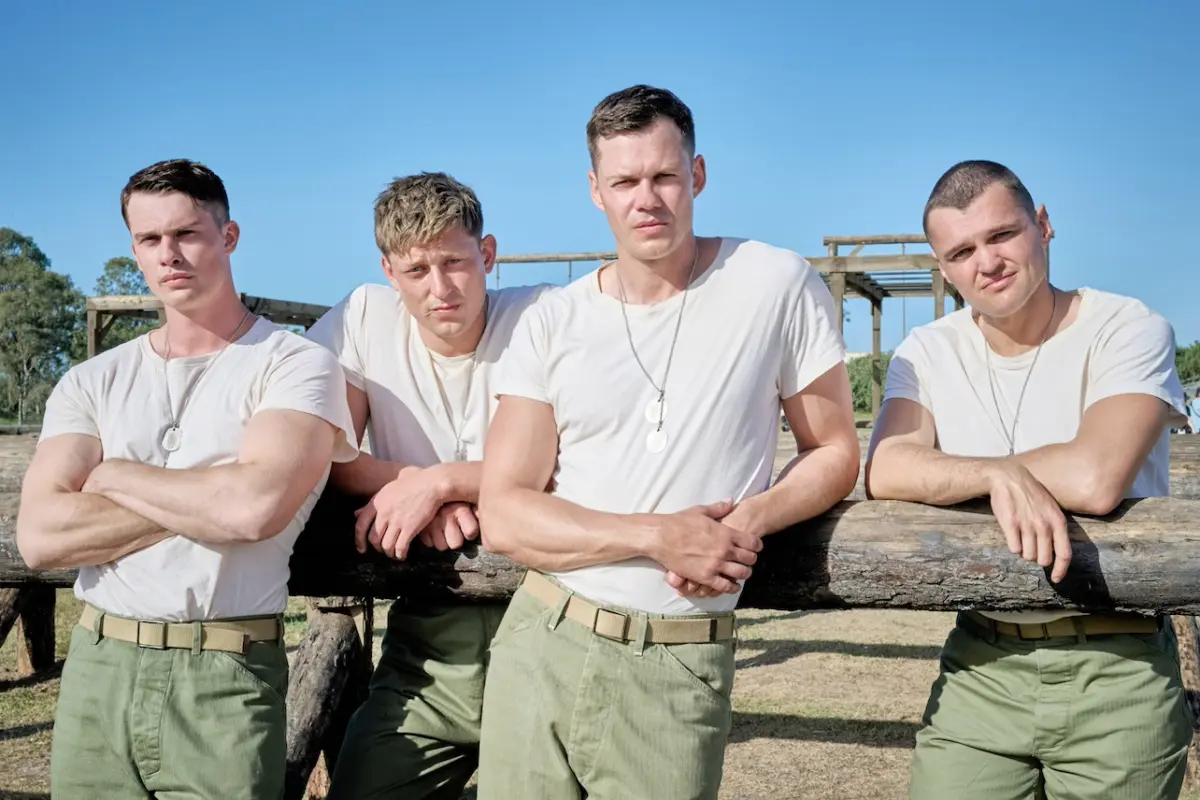
Specifically, it’s 1941, the day before Pearl Harbor. Berg adds real-life historical clips of that terrible day, then casts our four bosses as Marines who will end up in the same battalion. The Mac is as stable as it gets. Bob is a bit of a joker. Touchdown Tony is a celebrity made to play pro, much to Dave’s annoyance. They’re abused at boot camp — especially by a typically yelling sergeant played by ESPN football commentator Pat McAfee — and then it’s 1943.
To be more precise, it is 1943 in Tarawa. Our Marines are in a boat headed for shore while boats and planes are firing shells and bullets in every direction. The boat rests on the boat and men are thrown out as bullets pass through the water, they swim, lose their weapons and helmets, get dirty as they climb the dams, and lose their innocence in the floods as they watch marines get their limbs blown off, their cavities filled with bullets, and their helmets accidentally taken off their heads. They’ll be in the jungle, going through sniper targets, soaking up trauma and more trauma like sponges that will never dry up. Finally, it’s the eve of the Battle of Okinawa, and a superior officer orders our four gridiron boys to set up a football game to boost morale. So they are. Christmas Eve, 1944.
What movies will this remind you of? So many movies since World War II Saving Private Ryan try, it’s too hard to redo Saving Private Ryan.
Performance worth watching: Galitzine is our main protagonist, but he is strangely passive; Nicholson exudes charisma, while Sarsgaard and Francis have their moments.
Gender and Leather: Naked manbuts while our boys swim in the ocean.
Our Reception: In a rare lull, Berg and Mark L. Smith’s screenplay skims a bit about the “nuance” in the Marines’ mission, and as the four leaders discuss what it is, the moment seems pretty ironic in a film that displays no nuance, from the ugly color palette to the handheld cinematography and the slick dialogue. He portrays the Japanese as faceless at best, suicidal maniacs at worst, and some Americans as gruesome collectors of skulls and teeth, like serial killers who find the only place in the world where their impulses are acceptable. These are four football-fighters who haven’t had much trouble in the middle, but have now seen more than any human can bear. WAR IS HELL, Berg screams at us.
And then there’s the violence, which is horrifically graphic Ordinary Ryan It created an unforgettable base for realistic depictions of war, but here it feels exploitative, just a shade of Mel Gibson-style sadism. Making us care more about these one-note characters can function to make the violence more emotionally impactful; as it is, it is nothing more than inviting us to look at the horror.
Berg compares the blood to a game of rah-rah, a fleeting slice of joy for these men, and the film highlights the moment very briefly before returning to the carnage. a weirder, harsher critique of the war itself (highlighted by archival footage of the mushroom cloud over Nagasaki). Mosquito net too much blood and guts, not enough heart and soul.
Our call: To be stupidly reductive, Berg fumbled the ball. PASS THIS.
John Serba is a freelance film critic from Grand Rapids, Michigan. Werner Herzog hugged him once.