 Skip to content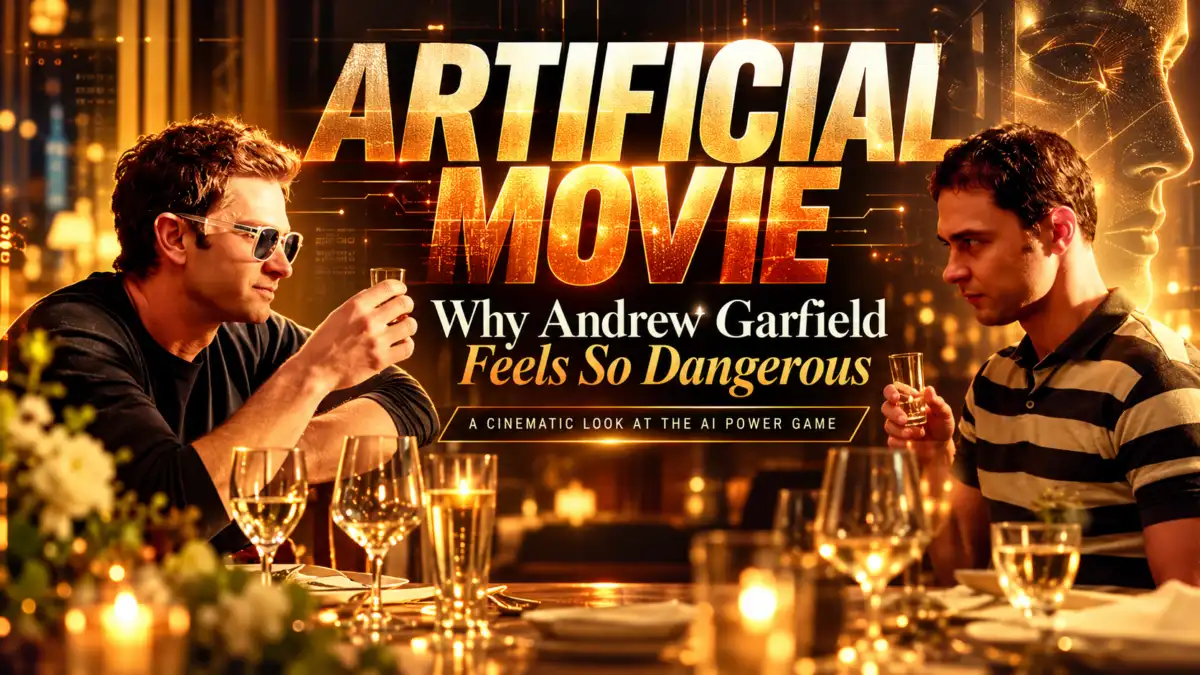
The people building artificial intelligence keep telling us the technology could transform the world. Luca Guadagnino’s Artificial movie asks a much more uncomfortable question: What happens when the people controlling that transformation become as important as the technology itself?
That question sits at the heart of Artificial, Guadagnino’s provocative new drama about the rise of OpenAI and the personalities behind one of the most consequential technology stories of the modern era.
Andrew Garfield steps into the role of Sam Altman, while Anora breakout Yura Borisov plays OpenAI co-founder and former chief scientist Ilya Sutskever. Rather than approaching the subject like a dry corporate history lesson, Guadagnino reportedly turns Silicon Valley ambition into something closer to a dark comedy crossed with a psychological thriller.
The result, according to early reviews, is funny, uncomfortable and difficult to dismiss.
Read More : The Social Reckoning Review: What Went Wrong
Artificial Movie Makes Sam Altman the Man You Can’t Ignore
Garfield’s transformation may be the biggest immediate talking point.
This is not the charming romantic lead audiences remember from The Amazing Spider-Man. Nor is it simply another imitation of a famous public figure.
The Artificial movie presents Altman through an intentionally disturbing dramatic lens.
TIME critic Stephanie Zacharek describes Garfield’s performance as both funny and deeply unsettling, while the film itself presents Altman as a calculating force inside the larger OpenAI story. At the same time, TIME argues that he isn’t actually the emotional center of the film. That position belongs to Sutskever.
That distinction matters.
Making Altman the obvious center would have turned Artificial into a conventional Silicon Valley biography. By shifting much of the emotional weight toward Sutskever, Guadagnino can explore something larger: what happens when scientific idealism collides with money, influence and corporate power.
Artificial Movie Gives Andrew Garfield a Complicated Target
Garfield appears to have approached the role with more curiosity than simple condemnation.
Speaking around the New York Film Festival premiere, the actor recalled initially seeing Altman as charismatic and transparent. Garfield said he then spent roughly two to three months studying footage of him while preparing for the performance.
That preparation could explain why the performance is attracting so much attention.
Garfield has played real people before, including Eduardo Saverin in The Social Network and Jonathan Larson in Tick, Tick… Boom!. But playing Altman presents a different challenge because the story surrounding AI is still unfolding.
There is no comfortable historical distance.
The technology is changing now. The companies are changing now. The public debate about regulation, safety, jobs and artificial general intelligence is happening now.
That gives the Artificial movie an unusual sense of urgency.
Artificial Movie Isn’t Really About Computers
Perhaps the smartest choice Guadagnino makes is refusing to turn the story into a movie about software.
Instead, Artificial appears interested in people.
It begins with the scientific world surrounding Geoffrey Hinton, played by Mark Rylance, before following Sutskever’s development as an ambitious young researcher. Eventually, those dreams lead toward OpenAI and Altman. TIME describes the film as tracing how optimistic ambitions surrounding AI become tangled with larger questions of power and responsibility.
That is considerably more cinematic than watching programmers stare at computer screens.
The real tension comes from a familiar human problem: people can begin with similar dreams and end up fighting over what those dreams should become.
OpenAI famously experienced one of Silicon Valley’s strangest corporate crises in November 2023, when Altman was removed as CEO and returned only days later. The film dramatizes that power struggle as part of its broader examination of OpenAI’s evolution.
And suddenly, the story isn’t just about artificial intelligence.
It’s about loyalty.
It’s about ambition.
It’s about who gets to make decisions that may eventually affect everyone else.
Yura Borisov Could Be Artificial’s Secret Weapon
Garfield may dominate the headlines, but Yura Borisov could be the reason the Artificial movie actually works emotionally.
Borisov plays Ilya Sutskever as the scientist whose belief in AI’s potential gradually runs into increasingly difficult moral questions.
TIME identifies Borisov’s character as the movie’s key figure, describing his journey from an awkward young researcher working with Geoffrey Hinton to an important player inside OpenAI.
Borisov is particularly well suited to that type of role.
His performance in Anora showed how much he can communicate without turning every emotion into a speech. That quiet quality could provide an effective contrast with the personalities and egos surrounding Silicon Valley’s AI race.
Early reaction has also singled him out. Variety reported strong praise for both Borisov and Garfield following the film’s New York Film Festival premiere.
Why the Artificial Movie Feels So Timely
There is another reason Artificial may land differently from previous tech dramas.
The audience already lives with the product at the center of its story.
Millions of people aren’t merely reading about artificial intelligence. They are using it for work, school, coding, entertainment, research and everyday questions.
That changes the relationship between viewer and movie.
When The Social Network examined Facebook, audiences already understood social media’s growing cultural power. Artificial arrives during an even faster technological transformation, when nobody can confidently describe what the AI landscape will look like several years from now.
Guadagnino uses that uncertainty as fuel.
TIME’s review portrays the movie as simultaneously exhilarating and pessimistic, mixing anxiety about AI with surprising humor rather than delivering a two-hour lecture about technology.
That may be its biggest advantage.
People rarely buy movie tickets because they want homework.
They buy tickets because they want characters, conflict, tension and entertainment.
Artificial appears determined to provide all four.
Artificial Movie Also Finds the Comedy in Silicon Valley
The film isn’t relentlessly grim.
Ike Barinholtz plays Elon Musk, and early reviews suggest his exaggerated presence provides some of the movie’s biggest laughs. Monica Barbaro appears as Mira Murati, while Mark Rylance portrays AI pioneer Geoffrey Hinton. Cooper Hoffman is also part of the sprawling ensemble.
That comic energy could prove essential.
A movie about existential AI risk can become exhausting quickly. Guadagnino instead appears to recognize something Hollywood has understood for decades: powerful people behaving strangely can be both frightening and extremely funny.
The humor doesn’t necessarily weaken the warning.
It can make the warning sharper.
Artificial Movie Walks a Dangerous Line Between Fact and Drama
Viewers should remember one important distinction.
Artificial is a dramatization.
Altman himself has indicated that he does not expect the movie to function as an accurate depiction of his life, and reports surrounding the film have already noted fictionalized elements.
That means scenes depicting private behavior should not automatically be interpreted as documentary evidence about the real people involved.
The better way to approach the Artificial movie is as Guadagnino’s argument about Silicon Valley culture — one built from recognizable people and historical events but shaped through screenplay, performance and cinematic exaggeration.
That distinction may also create debate once the movie reaches a wider audience.

Artificial Movie Could Become One of Christmas’ Biggest Conversations
The timing couldn’t be better for controversy.
Artificial premiered at the New York Film Festival on October 5, 2026. NEON currently has the film scheduled to open in U.S. theaters on December 25, 2026.
Christmas Day isn’t exactly subtle positioning.
While holiday audiences traditionally get prestige dramas, musicals and major crowd-pleasers, Artificial arrives with one of the most politically, culturally and technologically charged subjects Hollywood could tackle.
It also enters awards season with significant attention already surrounding Garfield and Borisov.
Whether audiences ultimately see the film as an essential warning, an unfair portrait of powerful tech executives or simply an entertaining piece of cinematic provocation may depend on what they already believe about AI.
But indifference seems unlikely.
And that might be exactly what Guadagnino wants.
The Artificial movie isn’t asking audiences to understand every technical detail behind artificial intelligence.
It’s asking something more personal:
Do we really know the people shaping the technology that could reshape our lives?
That question will probably remain long after the credits stop rolling.