 Skip to content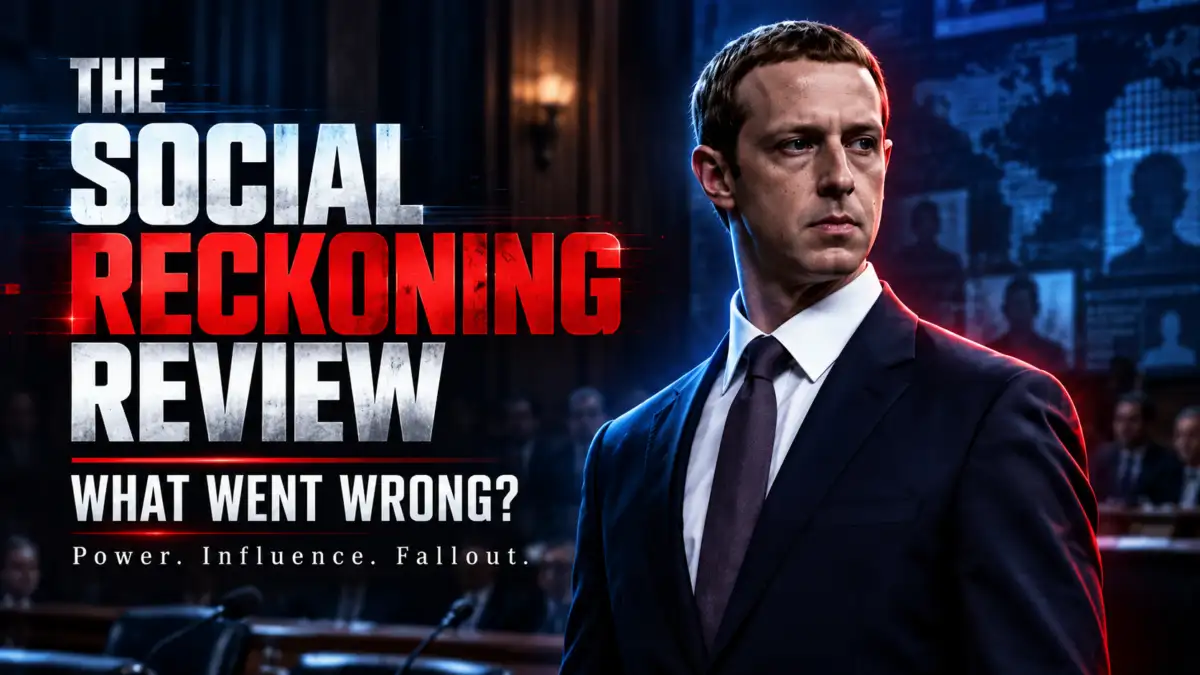
The Social Reckoning Review: Sorkin Returns to Facebook
Sixteen years after The Social Network turned the creation of Facebook into one of the sharpest dramas of the modern era, Aaron Sorkin is going back to Silicon Valley. This time, however, the question is no longer how Facebook was built. It is what happened after the platform became powerful enough to influence the way billions of people communicate, consume news and argue with one another.
That makes The Social Reckoning sound like a natural continuation of the 2010 film. On paper, it has almost everything a prestige Hollywood drama could want: whistleblowers, investigative journalism, corporate power, political tension and a cast packed with major names.
Yet this The Social Reckoning Review arrives at a more complicated conclusion. The story is important. The actors are impressive. The accusations at the center of the film remain disturbing. But importance alone does not automatically produce great cinema.
BBC critic Nicholas Barber was particularly unconvinced, awarding the film two stars out of five and arguing that Sorkin’s treatment is too dramatically restrained for a subject this volatile. Other critics have been more positive, making the early response noticeably divided.
Read More: Dolly Parton Estate: Barbed Wire Claim Raises Stakes
The Social Reckoning Review: What Is the Movie About?
The Social Reckoning is inspired by events surrounding the Facebook Files.
Mikey Madison plays Frances Haugen, the Facebook engineer who becomes increasingly concerned about what is happening inside the company. Jeremy Allen White plays Jeff Horwitz, the Wall Street Journal reporter who helps bring the information into public view.
Sony Pictures describes the movie as a companion piece to The Social Network rather than a conventional sequel. Aaron Sorkin writes and directs, while Jeremy Strong steps into the role of Mark Zuckerberg previously associated with Jesse Eisenberg.
The shift is important.
The Social Network was fundamentally a story about ambition, friendship, betrayal and the birth of an empire. The Social Reckoning begins after that empire has already won.
Now the conflict is about consequences.
Facebook’s algorithms, misinformation, political extremism and the company’s decisions about engagement become part of the drama. The film moves toward the revelations that became the Facebook Files and examines the uncomfortable possibility that the platform understood some of its problems long before the public did.
That should be gripping material.
Sometimes it is.
But not often enough.
Jeremy Strong Makes Zuckerberg Feel Colder
The casting decision guaranteed attention.
Jeremy Strong takes over as Mark Zuckerberg, replacing Jesse Eisenberg, whose performance in The Social Network became one of the defining screen portrayals of a modern technology executive.
Strong wisely does not try to reproduce Eisenberg.
His Zuckerberg feels older, more controlled and much harder to read. The young programmer fighting to establish his company has disappeared. What remains is the leader of a massive institution defending decisions with consequences far beyond Silicon Valley.
That colder interpretation fits the story Sorkin wants to tell.
Strong also has the screen presence to make even quiet scenes unsettling. He does not need an explosive confrontation to suggest power. At times, Zuckerberg seems most intimidating when he barely reacts at all.
Still, The Social Reckoning Review cannot place the movie’s weaknesses at the feet of its cast. Strong is working inside a film that frequently wants its arguments to carry more weight than its characters.
Read More : Eva Marie Saint Death: The Choice That Defined Her Legacy
Mikey Madison Gives the Story Its Human Center
Mikey Madison has one of the film’s toughest assignments.
Her Frances Haugen has to function both as a recognizable human being and as the audience’s doorway into a complicated story involving algorithms, internal research, corporate policy and investigative reporting.
Madison brings restraint to the performance.
She does not turn Haugen into an exaggerated movie hero. The tension comes from watching someone slowly understand the scale of what she knows and what revealing it could mean.
Jeremy Allen White gives Jeff Horwitz a different energy. As the Wall Street Journal reporter working through the evidence, he helps shift the film into investigative-journalism territory.
The pairing occasionally recalls movies such as Spotlight and All the President’s Men, where documents, sources and seemingly ordinary conversations gradually expose something much larger.
The difference is that Sorkin rarely allows the material to become as suspenseful as its implications suggest.
The Social Reckoning Review: The Biggest Problem
Here is where the movie begins losing its grip.
Sorkin remains one of Hollywood’s most recognizable dialogue writers. Characters exchange information quickly. Arguments arrive polished. People seem able to explain complicated ideas without searching for the right words.
When that rhythm works, it can be exhilarating.
When it doesn’t, audiences become aware that everyone is speaking with the screenwriter’s voice.
That problem is especially noticeable in The Social Reckoning because the movie carries so much information. Algorithms, engagement statistics, Facebook policies and journalistic procedures all need to be explained.
The result sometimes feels less like characters discovering something frightening and more like a film making its case to a jury.
The Guardian likewise found the drama fast and engaging but questioned several of its dramatic choices, while the Associated Press described it as meaningful and relevant even though it falls short of its predecessor.
The Social Reckoning Review: Missing David Fincher
There is another unavoidable problem.
David Fincher did not direct this movie.
Sorkin directed it himself.
Comparisons may seem unfair, but The Social Reckoning deliberately exists in the shadow of The Social Network. Fincher turned computer screens, depositions, nightclubs and conference rooms into visually charged spaces. His camera made conversations feel dangerous.
Here, the filmmaking is more functional.
That difference explains much of the frustration surrounding The Social Reckoning Review reactions. The movie frequently has something provocative to say, yet the images do not always carry the same electricity as the dialogue.
The Atlantic’s review similarly argued that the sequel lacks the visual energy and emotional character dynamics that helped make the original so memorable.
The Social Reckoning Review: Why January 6 Changes the Mood
The movie gains considerably more force when its story approaches January 6, 2021.
Suddenly, discussions about engagement, algorithms and online extremism are no longer abstract.
The consequences are visible.
That gives the later section of The Social Reckoning an urgency missing from parts of its first half. Several critics have identified this stretch as one of the film’s strongest, with the proximity of the events making the sequences particularly uncomfortable.
Sorkin’s argument becomes difficult to ignore: a platform built to connect people can also amplify division when anger becomes valuable engagement.
Whether the movie proves every part of that argument is another matter.
But it certainly knows what it wants audiences to think about on the drive home.

Is The Social Reckoning Better Than The Social Network?
No.
That is an almost impossible standard anyway.
The Social Network combined Sorkin’s screenplay, David Fincher’s direction, Jesse Eisenberg’s performance and an unmistakable sense that audiences were watching the beginning of something whose consequences were still unfolding.
The Social Reckoning has the opposite challenge.
We already know many of the consequences.
That makes surprise harder.
Instead of asking, “What will Facebook become?” the new film asks something more uncomfortable: “We know what happened. So why didn’t knowing change more?”
That question ultimately gives the movie its relevance.
It also exposes its biggest limitation.
The real world may be more unsettling than Sorkin’s dramatization of it.
Final Verdict
The Social Reckoning Review ultimately comes down to a frustrating contradiction.
Aaron Sorkin has chosen a subject with enormous stakes. Frances Haugen’s story deserves attention. The Facebook Files remain an extraordinary piece of investigative journalism. Jeremy Strong, Mikey Madison and Jeremy Allen White give the movie considerable star power.
But The Social Reckoning never consistently turns that material into the kind of tense, unforgettable drama its subject seems to demand.
BBC’s harsh two-star verdict reflects that disappointment, although the broader critical response shows the film is far from universally dismissed. Some reviewers see an engaging, angry warning about social media power; others see a visually flat sequel arriving after audiences already understand much of its argument.
Perhaps that division is appropriate.
The Social Network showed us the moment Facebook became powerful.
The Social Reckoning asks what happened when that power became almost impossible to control.
The answer should be terrifying.
The movie is merely unsettling.
The Social Reckoning opens exclusively in U.S. theaters October 9, 2026.
1 thought on “The Social Reckoning Review: What Went Wrong?”