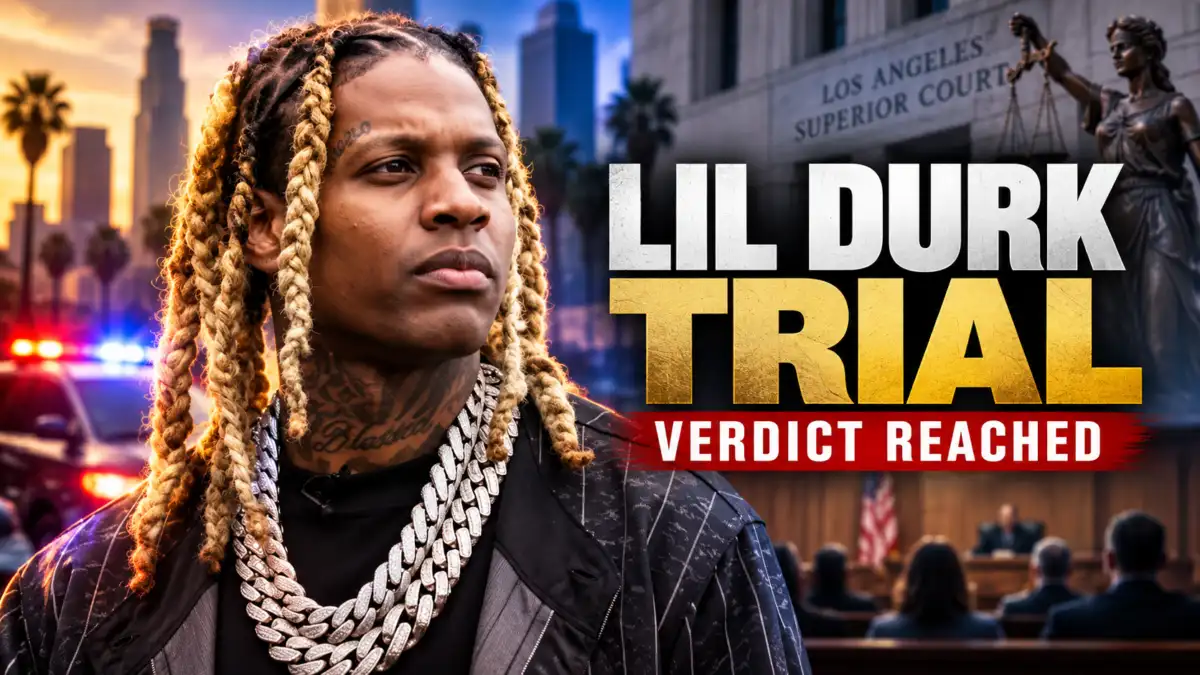
Lil Durk Trial: Tense Wait as Jury Reaches Verdict
Lil Durk trial jurors have reached a verdict after three days of deliberations in the Grammy-winning rapper’s federal murder-for-hire case in Los Angeles, bringing one of hip-hop’s most closely watched criminal trials to its decisive moment.
There’s one major catch. As of the latest verified reporting Friday, September 11, 2026, the jury’s actual decision had not yet been publicly read in court. NBC Los Angeles and ABC reported that jurors had completed their work and that the verdict was expected to be announced Friday afternoon.
That distinction matters. Searches for lil durk verdict today exploded as word spread that the jury had reached a decision, but a verdict being reached isn’t the same thing as a guilty or not-guilty verdict being publicly confirmed.
Until the judge receives the verdict in open court and the findings are read, claims circulating on social media about Durk being convicted or acquitted should be treated exactly as they are: unverified claims.
And in a case carrying the possibility of life in federal prison, guessing would be pretty irresponsible.
Lil Durk Trial Verdict Reached After Three Days
Lil Durk, whose legal name is Durk Banks, went on trial alongside Deandre “DeDe” Wilson and David “Browneyez” Lindsey in federal court in Los Angeles.
All three pleaded not guilty.
The jury began deliberating Wednesday, September 9, following closing arguments. Jurors returned Thursday with questions about important parts of the law, then continued working Friday before informing the court that they had reached a verdict.
ABC reported Friday that the decision came after three days of deliberations. NBC Los Angeles separately confirmed that a verdict had been reached in the case involving the August 2022 shooting near the Beverly Center.
For anyone refreshing searches for the Durk Banks verdict, that’s the current confirmed status: the jury has decided, but the result still needs to be formally announced.
The timing makes the wait feel even more intense. Jurors spent two full days asking for evidence and clarification rather than rushing through five serious federal charges.
That doesn’t reveal which way they voted. It does tell us they were digging into the details.
What Is the Lil Durk Murder-for-Hire Trial About?
The Lil Durk murder-for-hire trial centers on an August 19, 2022 shooting near the Beverly Center in Los Angeles.
Federal prosecutors allege that Quando Rondo, whose legal name is Tyquian Bowman, was the intended target.
Bowman survived.
His cousin, 24-year-old Saviay’a “Lul Pab” Robinson, was killed.
According to NBC Los Angeles, prosecutors told jurors that gunmen fired at least 18 rounds toward the vehicle carrying Bowman and Robinson. The government alleges that Banks financed and helped organize a team that traveled from Chicago to California intending to kill Bowman.
Prosecutors framed the attack as retaliation connected to the November 2020 death of Dayvon “King Von” Bennett, the Chicago rapper and Durk associate who was killed during an altercation outside an Atlanta nightclub.
The government’s theory is straightforward but legally demanding: prosecutors needed to convince jurors beyond a reasonable doubt that Banks knowingly participated in the alleged plan, rather than simply having relationships with people who committed crimes.
Durk’s lawyers have rejected the government’s version from the beginning.
They argued that their client did not orchestrate the shooting and that prosecutors were trying to connect him to other people’s actions through cooperating witnesses, communications and circumstantial evidence.
That fight over intent became one of the central questions of the trial.
The Five Charges Jurors Considered
NBC Los Angeles reported that Banks faced five counts involving conspiracy, stalking, stalking resulting in death and murder-for-hire allegations. His co-defendants also pleaded not guilty to the charges being considered by the jury.
The legal wording matters here.
Prosecutors didn’t have to prove that Durk personally fired a weapon. Their burden was to establish the elements of the charged offenses, including whether he intentionally joined or facilitated the alleged criminal plan.
That’s where the case became complicated.
A celebrity connection isn’t enough. Friendship isn’t enough. Anger isn’t enough.
The government had to connect those pieces to criminal intent beyond a reasonable doubt, while the defense only needed to establish reasonable doubt about the prosecution’s theory.
Why “Intent” Became Huge in the Lil Durk Trial
Thursday’s jury questions gave the public its clearest look at what jurors were studying.
The panel asked U.S. District Judge Michael W. Fitzgerald for clarification surrounding conspiracy, what makes someone a conspirator, the meaning of an overt act and the meaning of “intent.”
Complex reported that one question specifically concerned Count 3 and whether a defendant possessed the required intent to kill, injure, harass or intimidate Robinson. Judge Fitzgerald did not create a new legal definition for the jury, instead directing jurors back to the instructions and the ordinary meaning of the word.
Those questions shouldn’t be treated as secret clues pointing toward conviction or acquittal.
Still, they’re revealing.
Jurors weren’t asking about some minor exhibit number. They were asking about concepts sitting close to the heart of the prosecution’s case.
Lil Durk Trial Jurors Also Wanted the Evidence Digitized
The jury made another unusual but practical request during its first day of deliberations: access to the admitted evidence in digital form.
That request delayed the process while the material was prepared.
Complex reported that jurors wanted the full body of evidence in a format they could review more easily. By Thursday morning, the jury had moved from reviewing evidence to asking detailed questions about conspiracy and intent.
That probably explains why anyone expecting a two-hour celebrity verdict was disappointed.
This was a multi-defendant federal case involving years of communications, testimony from cooperating witnesses, travel evidence and competing explanations about who organized the 2022 trip to California.
Three days of deliberation isn’t shocking under those circumstances.
If anything, the jury appears to have taken the assignment seriously.
OTF Jam Testimony Became a Major Battleground
One of the most closely followed parts of the trial was the OTF Jam testimony.
Kacey Hester, known as OTF Jam, testified for the government after admitting his involvement in the shooting that killed Robinson.
Hester told jurors that he had known Durk since roughly 2007. According to The Source, Hester testified that Banks financially supported him during and after an earlier prison sentence and later played a role in organizing and financing the California trip connected to the alleged plot against Quando Rondo. Durk has denied wrongdoing and pleaded not guilty.
Hester also admitted something prosecutors couldn’t exactly hide from jurors: his own serious criminal conduct.
He acknowledged participating in the shooting.
That gave the defense an obvious line of attack.
Attorney Brian Steel aggressively challenged Hester’s credibility, arguing that someone admitting to violent crimes while cooperating with prosecutors had reasons to help the government.
And this wasn’t a small credibility dispute buried somewhere on Day 2.
It became a core question for jurors: how much should they trust insiders who admitted committing crimes themselves?
The government’s position was that those witnesses could explain conversations and relationships outsiders couldn’t.
The defense’s answer was basically: look very carefully at who is talking and what they stand to gain.
That’s a real jury problem. There’s no shortcut around it.
The Defense Pointed at Kavon Grant
Durk’s attorneys also offered jurors an alternative explanation for the shooting.
NBC Los Angeles reported that the defense placed responsibility on former Durk personal assistant Kavon Grant, arguing that Grant arranged the intended attack to impress his boss rather than acting on Banks’ orders. Grant later became a government witness.
Prosecutors saw the same relationships very differently.
They argued that Banks stood above the people carrying out the alleged plan and that the trail of testimony, communications and financial arrangements connected him to what happened in Los Angeles.
So jurors were left with two dramatically different pictures.
In the government’s version, Durk used his position and resources to set a revenge plot in motion.
In the defense version, prosecutors built their case around cooperating criminals and then attached their conduct to a famous defendant who didn’t order the killing.
There isn’t much middle ground between those theories.
Quando Rondo Shooting Case Started With a Deadly 2022 Ambush
The Quando Rondo shooting case traces back four years from the current verdict.
On August 19, 2022, Bowman was inside a black Cadillac Escalade near the Beverly Center area when gunfire erupted.
Robinson was killed.
Bowman survived the attack.
Los Angeles Times reporting from the investigation described gunmen getting out of a vehicle and opening fire after Bowman’s group reached a gas station near Beverly Boulevard. Federal investigators later tied the shooting to an alleged plot involving members or associates of Only The Family, the collective founded by Durk.
Prosecutors allege Bowman was targeted because of the events surrounding King Von’s death in Atlanta in November 2020.
That alleged revenge motive became the narrative spine of the federal prosecution.
But motive by itself isn’t a conviction.
The jury still had to decide whether the government proved that Banks actually joined the criminal scheme charged in the indictment.
Lil Durk’s Career Raised the Stakes Outside Court
Banks entered this trial as far more than a local Chicago rapper.
He won the Grammy Award for Best Melodic Rap Performance in 2024 for “All My Life,” his collaboration with J. Cole. By the time federal authorities arrested him in 2024, he had spent years moving between Chicago drill music and mainstream American hip-hop. NBC notes that he has remained in federal custody in Los Angeles since that arrest.
That fame has turned every court development into content.
A jury note becomes a viral post. A courthouse comment becomes a livestream topic. Somebody tweets “guilty,” another person posts “free Durk,” and suddenly thousands of people repeat it before checking whether a judge has even entered the courtroom.
Friday produced exactly that problem.
Once reports confirmed that the jury had reached a verdict, online speculation quickly started treating “verdict reached” as though the actual verdict had already been revealed.
It hadn’t, according to the latest confirmed reporting used for this report.
That’s why the wording matters.
What Happens After the Lil Durk Trial Verdict Is Read?
Once the verdict is formally read, each count should produce a finding for each defendant covered by the jury’s decision.
A guilty verdict on the most serious charges could expose Banks to life in federal prison. NBC Los Angeles reported that Durk faces the possibility of a life sentence if convicted.
An acquittal would obviously change the immediate picture, but it wouldn’t necessarily close every federal case involving him.
Separate federal racketeering allegations were severed from this proceeding. Reporting on the July ruling indicates those charges remain outside the case currently being decided and could be handled in a later trial.
That point has caused plenty of confusion online.
A not-guilty verdict in this trial would mean the government failed to secure a conviction on these particular charges. It wouldn’t automatically erase separate pending allegations.
The same principle works in the other direction. If Banks is convicted, sentencing would come later rather than occurring the instant jurors announce their decision.
Federal criminal cases move in stages.
The viral posts usually don’t.
Why the Lil Durk Verdict Today Matters
Whatever jurors decided, this lil durk verdict today moment is bigger than another celebrity-court headline for one simple reason: the consequences are concrete.
A 33-year-old defendant could face life imprisonment.
A 24-year-old man, Saviay’a Robinson, was killed.
Two other defendants are waiting for decisions about their own futures.
And a jury has spent three days sorting through competing stories about a shooting that happened in broad daylight in Los Angeles more than four years ago.
That deserves more care than turning the courthouse into a scoreboard.
Fans can argue over Durk’s music. They can debate witnesses. They can dislike prosecutors or question defense strategies.
But the verdict itself has only one reliable source: the courtroom.
Lil Durk Trial Now Waits for the Jury’s Decision to Be Read
The latest verified development is clear.
The jury has reached its verdict.
NBC Los Angeles reported Friday that the decision was expected to be announced soon, while ABC reported that it was expected to be read aloud in court Friday afternoon.
Until that happens, publishing “Lil Durk found guilty” or “Lil Durk found not guilty” without confirmation is getting ahead of the facts.
After weeks of testimony, five federal counts and three days of deliberations, waiting a little longer for the actual words from the courtroom isn’t difficult.
And with a potential life sentence involved, it’s the only responsible way to report it.