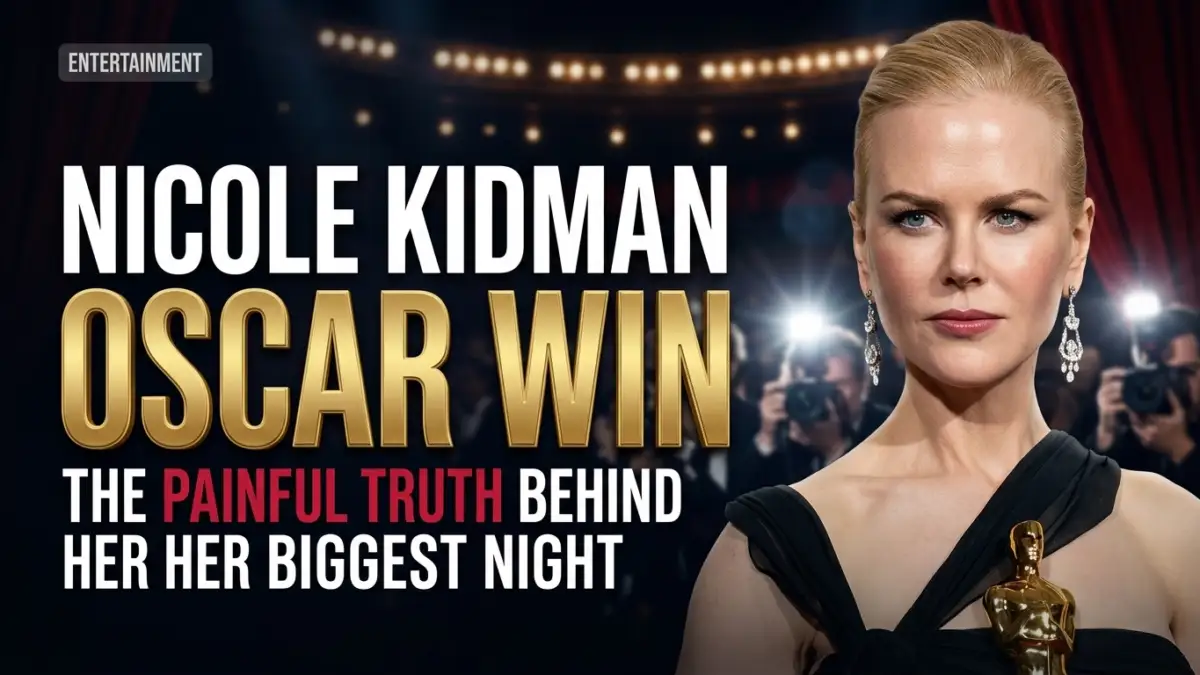
Nicole Kidman Oscar Win Exposed a Painful Truth
Nicole Kidman Oscar win should have delivered the kind of Hollywood night actors spend decades chasing. On March 23, 2003, Kidman walked onto the stage at the 75th Academy Awards and accepted the Best Actress trophy for playing Virginia Woolf in The Hours. Cameras flashed. Her career was soaring.
Then she went home feeling desperately alone.
More than 23 years later, the 59-year-old actress has put surprisingly direct language around that contradiction. During the September 10, 2026 episode of Therapuss with Jake Shane, where she appeared alongside Sandra Bullock while promoting Practical Magic 2, Kidman said she was “beyond lonely” after reaching what was then the highest professional point of her career.
That confession is more interesting than another polished Oscar memory. Hollywood usually sells awards season as a straight line from nomination to champagne, photographers and career validation. Kidman’s version has a hotel room at the other end of it.
And that’s the real story.
Why the Nicole Kidman Oscar Win Felt So Lonely
The Nicole Kidman Oscar win arrived after a remarkable run for the Australian actress.
Kidman had already received an Academy Award nomination for Moulin Rouge! before portraying author Virginia Woolf in Stephen Daldry’s 2002 drama The Hours. At the 2003 ceremony, she competed in the Best Actress category against Salma Hayek for Frida, Diane Lane for Unfaithful, Julianne Moore for Far from Heaven and Renée Zellweger for Chicago.
That’s a serious field.
The Academy’s official record shows The Hours earned nine nominations that year, including Best Picture, directing, adapted screenplay and acting nominations for Kidman, Moore and Ed Harris. Kidman’s Best Actress victory became the movie’s sole Oscar win.
Professionally, there wasn’t much higher she could climb that evening.
Emotionally, it was different.
On the Nicole Kidman Therapuss podcast appearance, Kidman explained that her mother and father were with her during the milestone, but she still found herself wondering where the partner was with whom she could privately share it. She described the Oscar itself as the industry’s “highest sort of prize,” while admitting gratitude and loneliness existed at the same time.
One wording point matters here. Some entertainment headlines have framed Kidman’s comments as saying she “paid the highest price” after winning. Her actual remarks, as reported from the podcast, describe the Oscar as the highest prize in the industry. That’s a small difference on a keyboard and a pretty big difference journalistically.
What Kidman was describing wasn’t punishment for winning an Oscar.
It was the shock of discovering that professional validation couldn’t fill a personal absence.
Nicole Kidman Oscar Win Followed the Tom Cruise Divorce
The Nicole Kidman Oscar win also can’t be separated from what had happened two years earlier.
Kidman and Tom Cruise married in 1990. Their marriage ended in 2001 after 11 years, meaning Kidman entered the 2003 Academy Awards after one of the most intensely watched celebrity breakups of that era.
The Tom Cruise divorce was more than tabloid background. Kidman has repeatedly connected that period of personal upheaval with the strange experience of seeing her career accelerate.
Back in 2012, she told DuJour that the divorce had been a shock and that healing took considerable time. ABC News reported her reflections at the time, years after the split and long after the Oscar victory had become part of Hollywood history.
So picture the timing.
Marriage over in 2001. The Hours released in 2002. Oscar night in March 2003.
Within roughly two years, one part of Kidman’s life had collapsed while another had delivered its most prestigious trophy.
That’s where Nicole Kidman loneliness becomes more than a catchy celebrity-news angle. She wasn’t saying the award meant nothing. Quite the opposite. She clearly understood exactly what she had achieved.
That made the emptiness sharper.
Public success had reached maximum volume while her private life felt unusually quiet.
The Hours Oscar Was a Career-Defining Victory
The The Hours Oscar win also deserves context because time can flatten major performances into a line on an awards résumé.
Kidman played Virginia Woolf in a movie built around three women connected through Woolf’s novel Mrs Dalloway. The role deliberately moved her away from the glamorous screen image that had followed movies such as Days of Thunder, Batman Forever and Moulin Rouge!.
Even the physical transformation became a talking point.
But the Academy wasn’t handing out an award for makeup. Kidman’s controlled, heavy performance anchored a film that received nine nominations, and the Best Actress award remains the only competitive Oscar win of her career as of September 2026. The Academy’s archive confirms the victory at the ceremony held at Hollywood’s then-Kodak Theatre on March 23, 2003.
That record makes her new comments hit harder.
People sometimes rewrite old achievements once enough time has passed. Kidman’s account has actually stayed remarkably consistent.
In 2013, reports of an interview with Harper’s Bazaar Australia showed her already talking about the strange emptiness that accompanied the Oscar victory. A decade later, she revisited the same night for Dave Karger’s 2024 book 50 Oscar Nights.
This isn’t a brand-new emotion designed for a 2026 promotional tour.
She’s been saying versions of it for years.
Nicole Kidman 2003 Oscar Night Didn’t End With a Dream Party
The details surrounding the Nicole Kidman 2003 Oscar night make the memory unusually vivid.
Kidman later recalled that she wasn’t eager to attend the traditional Vanity Fair Oscar party. Friends and colleagues encouraged her to go and carry the trophy through the celebration, but she felt uncomfortable with the ritual. According to her recollection published in connection with 50 Oscar Nights, she became overwhelmed rather than exhilarated.
Contemporary coverage confirms Kidman did appear at the Vanity Fair gathering. A March 25, 2003 Los Angeles Times report described her at the party greeting people while Oscar winners and celebrities filled the room.
From outside, it looked exactly right.
Winner. Party. Famous faces everywhere.
Her later account tells a very different story about what was happening internally.
Kidman eventually returned to the Beverly Hills Hotel, where she has said she ordered takeout and ate on the floor of her room. It’s an almost absurdly ordinary image after the ceremony Hollywood treats as its grandest night: an Academy Award nearby, hotel food on the floor, no glamorous closing scene.
That’s the detail that sticks.
Not the dress.
Not the photographers.
The takeout.
Nicole Kidman Oscar Win Became a Personal Wake-Up Call
For Kidman, the Nicole Kidman Oscar win apparently forced a question that career achievement couldn’t answer: Who do you share your life with after everybody stops applauding?
During the 2026 podcast conversation, she said that realization became one of those profound moments when she thought, “I’ve gotta get a life.”
It’s a funny line on paper. Kidman was already an internationally famous movie star with an Oscar in her hands.
But that’s why it works.
She wasn’t talking about getting a better job, another film or a larger house. She was talking about building something outside the machinery of work.
The distinction gets lost constantly in celebrity coverage. We count awards, opening weekends, streaming rankings and red-carpet appearances because those numbers are visible. Personal fulfillment doesn’t arrive with a box-office chart.
Kidman’s story makes the contrast unusually clean.
Nine nominations for The Hours. One win for the film. One gold trophy for Kidman.
And one lonely hotel room.
Why Nicole Kidman Loneliness Is Back in the Spotlight in 2026
The timing of the latest Nicole Kidman loneliness comments carries another layer.
Kidman married country star Keith Urban in 2006, three years after winning her Oscar. They later welcomed daughters Sunday Rose and Faith Margaret. After 19 years of marriage, Kidman filed for divorce in September 2025, and the divorce was finalized in January 2026.
She is therefore revisiting the loneliness of 2003 while living through another major reset in her personal life.
That doesn’t mean the two experiences are identical. Kidman herself has resisted reducing different relationships and breakups into one simple emotional formula. Her recent British Vogue interview presented her as facing a future that feels less predictable than it once did.
Still, the parallel is hard to miss.
In 2003, her career was flourishing while she adjusted to life after Cruise.
In 2026, she’s promoting Practical Magic 2 and remaining highly visible professionally after the end of another long marriage.
Hollywood loves a comeback narrative. Real life is usually messier than that.
What the Nicole Kidman Oscar Win Still Says About Success
The Nicole Kidman Oscar win has aged into something more useful than a standard awards-season victory story.
It shows how little an audience can know about a celebrity from the photographs taken during a single night.
A person can smile beside a gold statue and still want to leave the party.
Both things can be true.
Kidman’s comments aren’t an argument against ambition, awards or career success. She has continued working at a pace that would exhaust plenty of performers half her age, moving between prestige dramas, television projects and commercial releases.
Her point is simpler.
The trophy couldn’t do the job of another human being.
And because she’s speaking about a night from 2003 rather than an event that happened last Tuesday, there’s enough distance to take the observation seriously without turning it into instant celebrity melodrama.
The consistency matters too. She discussed the emotional emptiness surrounding the victory in interviews years ago, revisited the afterparty experience for a 2024 book, and returned to the memory on Therapuss in September 2026.
Same night. Same basic feeling.
That’s stronger evidence than a convenient promotional sound bite.
Nicole Kidman Oscar Win Story Cuts Through Hollywood’s Gloss
There is also something refreshing about Kidman refusing to pretend she enjoyed every second.
Awards culture practically requires winners to perform happiness correctly. Cry, but not for too long. Thank everyone. Attend the party. Hold the statue. Look overwhelmed in a photogenic way.
Kidman’s version is less tidy.
She was grateful. She was successful. And she felt awful.
The Academy record will always show The Hours Oscar victory beside Nicole Kidman’s name. It won’t show what happened once the cameras were gone, and that’s exactly why her comments more than two decades later are worth hearing.
For entertainment journalism, that’s the part worth protecting from sensationalism. Kidman didn’t say an Oscar destroyed her life, and she didn’t claim success itself was a mistake. She described an emotional contradiction: achieving the professional thing she’d worked toward while recognizing that another part of life felt painfully incomplete.
That’s a much better story than the clickiest interpretation.
The statue was real.
So was the loneliness.
And somewhere between the two sits a reminder Hollywood doesn’t put on its red carpets: sometimes the biggest night of your career ends with takeout on a hotel-room floor.