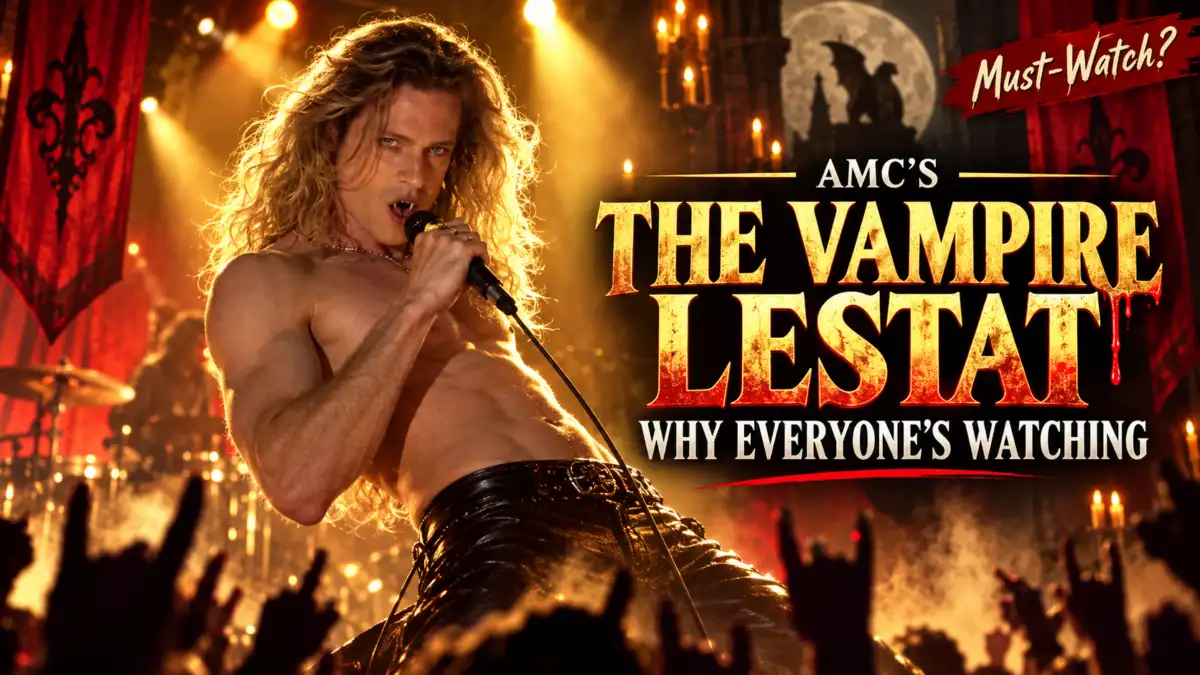
The Vampire Lestat Has a Secret Weapon—and It’s Not Blood
If you thought Lestat de Lioncourt was dramatic before, handing him a microphone was always going to be dangerous.
The Vampire Lestat takes one of Anne Rice’s most famous characters out of candlelit rooms and shadowy drawing rooms and drops him into something arguably even more dangerous: modern celebrity culture.
The result is not simply another season of vampire television.
It is part gothic drama, part rock spectacle and part character study of a man who has spent centuries believing every room should revolve around him.
And somehow, it works.
Sam Reid returns as Lestat, but this version of the character feels bigger, louder and more exposed than the vampire audiences met in Interview with the Vampire. Instead of hiding what he is, Lestat builds a public persona around it. He becomes a rock star, goes on tour and turns his complicated history into performance.
AMC described the season as following Lestat on an electric multi-city tour while figures from his past continue to haunt him. The network also took the music beyond the show itself, releasing original Lestat tracks performed by Reid on major streaming platforms.
That decision could easily have felt like a gimmick.
It doesn’t.
The Vampire Lestat Finally Gives Lestat the Stage He Wants
Lestat has never been a character built for subtle entrances.
He wants attention. He wants affection. He wants control. More than anything, he wants to decide which version of his story survives.
That makes rock stardom an almost suspiciously perfect fit.
Becoming a famous musician gives Lestat what immortality alone never could: an audience willing to watch him voluntarily.
The fascinating part is what happens after he gets it.
The concerts, interviews, costumes and screaming fans create a new layer around a character who has always performed different versions of himself for the people closest to him. Now that performance is happening on an enormous public stage.
Celebrity becomes another vampire costume.
The louder Lestat gets, the more the series has room to examine what might be hiding underneath all that noise.
Sam Reid Understands the Assignment
The show would collapse quickly if its lead actor treated Rockstar Lestat as a joke.
Sam Reid doesn’t.
He plays the character with enough commitment that the outrageous parts begin to feel believable within the world of the series. One minute Lestat can look completely comfortable commanding an arena; the next, Reid lets a flash of insecurity or old anger break through.
That tension has always been central to his interpretation of the character.
Lestat can be charming and cruel in the same conversation. He can appear completely certain of himself while clearly carrying emotional damage that has survived longer than most civilizations.
The rock-star material simply gives Reid another instrument to play.
And yes, he actually performs the music.
AMC and Lakeshore Records released original tracks including “Long Face” and “All Fall Down,” with music and lyrics from series composer Daniel Hart and vocals performed by Reid.
That matters because the songs are not treated like random promotional extras. Music becomes part of Lestat’s public identity and part of the storytelling machinery around him.
This Is More Than a Vampire Show With Guitars
Strip away the stage lights and leather, and The Vampire Lestat is still asking the questions that have made Anne Rice’s vampires endure for decades.
What does immortality do to love?
What happens when guilt has centuries to grow?
Can someone change after spending hundreds of years repeating the same emotional patterns?
And what happens when a creature accustomed to secrecy suddenly discovers mass media?
That last question gives this chapter a particularly modern edge.
Lestat does not enter a world where fame is controlled by a handful of newspapers or television networks. He enters a culture of clips, fandom, theories, celebrity obsession and nonstop interpretation.
Every performance can become evidence.
Every lyric can become a clue.
Every public appearance can become mythology before the night is over.
For a vampire who has spent years struggling over who gets to tell his story, that is practically irresistible.
The Music Makes the Reinvention Work
Turning Lestat into a rock musician is not something the series hides in the background.
It commits.
That commitment is probably the biggest reason the concept survives.
The production does not seem embarrassed by the excess. It understands that Lestat himself is excessive.
A restrained version of this idea would probably feel stranger.
Instead, the series lets the music, fashion and stage persona become extensions of the character. The concerts are not distractions from the gothic atmosphere. They are a newer, brighter version of it.
The darkness is still there.
Someone just plugged it into an amplifier.
That also gives the show permission to move between tones that would be risky almost anywhere else. Horror can sit beside romance. Tragedy can collide with camp. A deeply emotional memory can share space with the absurdity of an immortal vampire becoming a touring celebrity.
It should be messy.
Lestat is messy.
You Don’t Need to Be an Anne Rice Expert
Longtime Anne Rice readers will naturally recognize more of the mythology surrounding Lestat and the characters moving through his past.
But the show is not interesting only because of its literary connections.
Its most accessible hook is simple: an immortal vampire becomes a rock star while the history he would rather control keeps catching up with him.
That is enough to get through the door.
Viewers coming from Interview with the Vampire will obviously have more emotional context, particularly regarding Louis de Pointe du Lac, played by Jacob Anderson, and the complicated relationships surrounding Lestat.
The returning cast also includes Assad Zaman, Eric Bogosian and Delainey Hayles, while Jennifer Ehle joins the story as Gabriella.
Still, the central attraction remains Reid’s Lestat.
Everything circles him because, naturally, Lestat would have it no other way.
The Show’s Biggest Trick Is Making Fame Feel Dangerous
Vampire stories traditionally build tension around secrecy.
Do humans discover the monster?
Does the vampire expose himself?
Can the supernatural world remain hidden?
The Vampire Lestat plays with the opposite possibility.
What if the vampire wants to be seen?
That shift changes the energy of the story.
Public attention becomes both protection and threat. The more famous Lestat becomes, the harder it is to separate performance from confession. His audience may think they are watching a carefully constructed persona, while viewers understand that portions of the supposed act may be much closer to the truth.
It creates a strange relationship between celebrity mythology and supernatural mythology.
People have always turned famous performers into larger-than-life figures.
Lestat simply happens to already be one.
Anne Rice’s Universe Is Getting Bigger
The series also arrives at an important point for AMC’s wider Anne Rice television universe.
AMC acquired rights to a large collection of Rice’s work, including The Vampire Chronicles and Lives of the Mayfair Witches, with the goal of building interconnected adaptations around those characters and stories.
That plan is moving forward.
Following The Vampire Lestat, AMC announced that the fourth season of Anne Rice’s Interview with the Vampire will carry the title Anne Rice’s Queen of the Damned, with Hannah Moscovitch serving as showrunner.
For viewers, that means Lestat’s rock-star era is not an isolated experiment.
It is part of a much larger supernatural story.
Why The Vampire Lestat Is Worth Watching
There are easier ways to make vampire television.
This is not one of them.
The Vampire Lestat takes a beloved gothic character, turns him into a contemporary rock star, builds original music around him and asks audiences to follow a story moving between celebrity spectacle and centuries of emotional baggage.
That is a considerable swing.
More importantly, the series appears to understand why the swing makes sense.
Lestat has always wanted the world to listen to him.
Now he finally has the microphone.
The dangerous part is finding out what he decides to say with it.