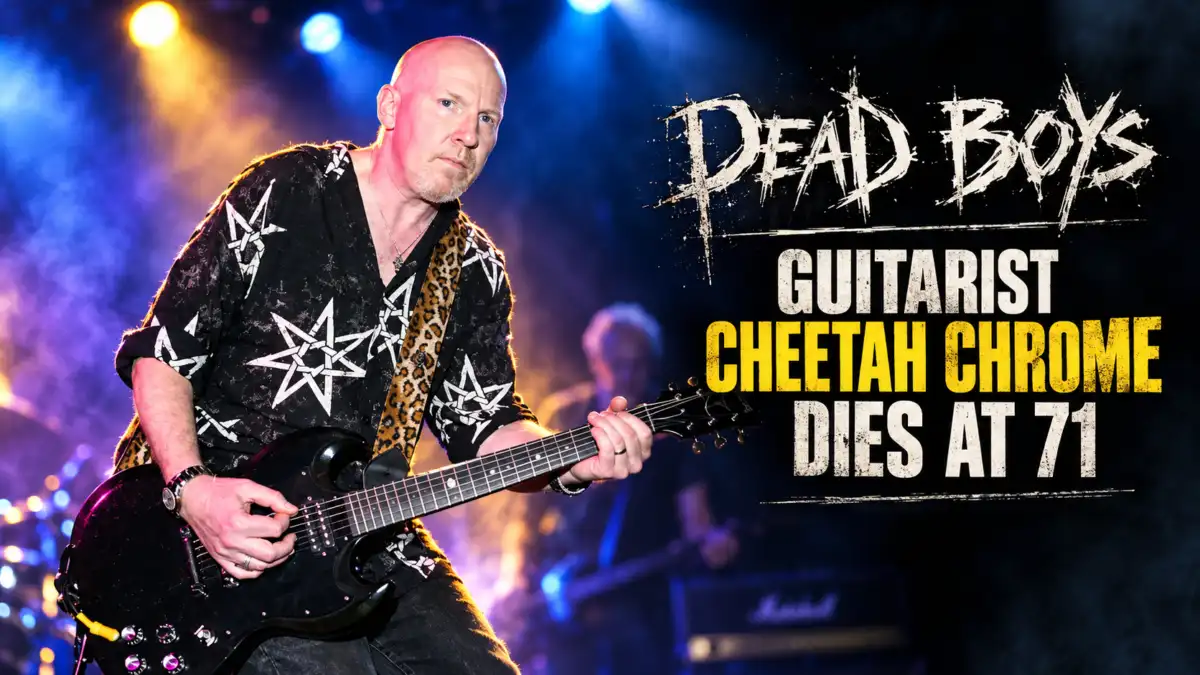
Cheetah Chrome, Dead Boys Guitarist, Dies at 71
Cheetah Chrome, the guitarist whose raw, unruly playing helped give the Dead Boys their unmistakable sound, has died at 71.
Chrome, born Eugene Richard O’Connor, died Sunday, Sept. 13, 2026. The Dead Boys confirmed his death in a statement shared with fans, but the band did not reveal a cause of death. The group asked for privacy as Chrome’s family, friends and longtime musical collaborators mourn him.
For anyone who came of age with the first wave of American punk, Chrome’s name is closely tied to the music’s early days. His guitar work with the Dead Boys was loud, jagged and deliberately rough around the edges. But behind that noise was a musician who understood how to make a guitar riff feel dangerous without losing its sense of rock ’n’ roll.
The Dead Boys remembered Chrome as a one-of-a-kind musician and an important figure in punk’s development. The band also made a point of remembering the person away from the stage, describing him as someone who genuinely loved rock music and was much sweeter than his ferocious stage reputation suggested.
From Cleveland to the Birth of American Punk
Chrome’s story began in Cleveland, a city that played an outsized role in the development of American underground rock during the 1970s.
In 1974, he joined Rocket From the Tombs, the influential Cleveland proto-punk group that also featured musicians including David Thomas and Peter Laughner. Although the band’s original run was brief, its music and members would have a lasting impact on the underground scene.
Rocket From the Tombs eventually fractured, sending its members in different musical directions. Chrome and drummer Johnny Blitz became part of the group that evolved into the Dead Boys alongside singer Stiv Bators, guitarist Jimmy Zero and bassist Jeff Magnum.
That lineup would soon become one of the most notorious bands associated with the earliest American punk movement.
The Dead Boys Take New York
The Dead Boys moved from Cleveland to New York in 1976, entering a music scene that was already beginning to change the direction of rock.
At the center of that world was CBGB, the legendary Bowery club that became a gathering place for bands such as the Ramones, Television and Patti Smith. The Dead Boys quickly became one of the venue’s most aggressive and unpredictable acts.
Chrome’s guitar was central to that identity.
Songs such as “Sonic Reducer” showed what made the Dead Boys different. The band was not interested in polished arena rock. Their music was fast, dirty and confrontational, but it still carried the attitude and swagger of classic rock ’n’ roll.
Their debut album, Young, Loud and Snotty, arrived in 1977 and became one of the defining records of the early American punk era. The group followed it with We Have Come for Your Children in 1978.
The Dead Boys’ original run, however, was short. They broke up in 1979 after releasing just those two studio albums.
The limited discography did little to diminish their reputation. In the years that followed, the Dead Boys became a reference point for musicians who wanted punk to sound dangerous, physical and completely unwilling to play by the rules.
Chrome’s Career Continued Long After the Dead Boys
The end of the Dead Boys did not end Chrome’s career.
He continued performing and recording, working with a wide range of musicians and projects. His post-Dead Boys credits included collaborations with Ronnie Spector and Nico, while he also spent time playing with other figures from the punk underground.
Chrome eventually reunited with Rocket From the Tombs in the 2000s, reconnecting with the Cleveland musical world that had helped shape him in the first place.
The reunion resulted in new recordings, including Rocket Redux, which finally gave the band’s old material a wider recorded life decades after its original formation. Later material became the album Barfly.
In 2010, Chrome teamed up with New York Dolls guitarist Sylvain Sylvain to form Batusis. The project released a four-song EP and performed at SXSW before touring in the United States.
Chrome also became an author.
His 2010 autobiography, Cheetah Chrome: A Dead Boy’s Tale From the Front Lines of Punk Rock, offered his own account of the chaotic world surrounding the early punk scene. The book gave fans a look beyond the mythology surrounding the Dead Boys and into Chrome’s experiences during those years.
A Life That Included More Than Punk
Chrome’s later years were not simply about looking backward.
After spending decades in the underground music world, he eventually settled in Nashville and became involved with Plowboy Records. He continued working in music while taking on projects that extended beyond the Dead Boys’ legacy.
His life had also been marked by periods of serious personal struggle. In a 2014 interview with VICE, Chrome spoke openly about his years of addiction and his eventual recovery. He described how an intervention involving CBGB owner Hilly Kristal and Dead Boys producer Genya Ravan helped push him toward getting his life back on track.
That chapter of his life became an important part of the story he told publicly. Rather than presenting himself simply as a punk survivor, Chrome was willing to talk about the consequences of the lifestyle that had surrounded the scene.
The Dead Boys Never Completely Disappeared
Although the original band ended in 1979, the Dead Boys returned for several reunion periods.
Chrome remained involved in later versions of the group, including a 2017 reunion celebrating the 40th anniversary of Young, Loud and Snotty. Chrome and drummer Johnny Blitz were joined by a newer lineup for performances and a re-recording project titled Still Snotty: Young, Loud and Snotty at 40.
The reunion also served as a reminder of just how much the band’s early work had endured.
Stiv Bators, the Dead Boys’ original singer, died in 1990 after being struck by a taxi in Paris. His death left another major gap in the band’s original lineup. Chrome nevertheless continued carrying the Dead Boys name and music into later decades.
Chrome’s Influence Reached Far Beyond Two Albums
It can be easy to measure a musician’s importance by record sales, chart positions or the size of an official discography.
Chrome’s influence is harder to quantify that way.
The Dead Boys made only two original studio albums during their initial run, but their approach became part of the foundation of American punk. Their sound combined the aggression of the emerging punk movement with the attitude and guitar-driven energy of older rock music.
Chrome was a major reason that formula worked.
His playing was not designed to sound perfect. It was supposed to hit hard.
That rawness became part of the appeal. The Dead Boys helped establish the idea that punk did not have to abandon the guitar hero tradition entirely. Instead, Chrome turned the volume up, stripped away the polish and made the instrument sound as volatile as the people playing it.
His work with Rocket From the Tombs also connected him to another branch of American alternative music history. The Cleveland scene that produced Rocket From the Tombs would eventually feed into several influential bands and musical movements.
Remembering Cheetah Chrome
Chrome’s connection to punk eventually reached popular culture as well.
The 2013 film CBGB, which dramatized the history of the famous New York club, featured Chrome as a character played by Rupert Grint. Chrome himself also appeared in the movie in a cameo.
By then, the world that had produced the Dead Boys was already decades in the past. Yet Chrome remained connected to it, whether through his music, his autobiography, reunion performances or conversations about the early punk scene.
His death now marks the loss of another musician who helped build that world from the ground up.
The Dead Boys said his music will continue to inspire future generations. That is perhaps the clearest measure of Chrome’s legacy.
He never needed a huge catalog to leave a huge mark.
Cheetah Chrome helped create a sound that was impossible to mistake: loud guitars, reckless energy and a refusal to smooth out the rough edges.
That sound remains alive every time someone puts on a Dead Boys record and hears the opening attack of “Sonic Reducer.”
No funeral or memorial arrangements have been publicly announced. The Dead Boys have asked fans and friends to respect the privacy of Chrome’s loved ones during this time.