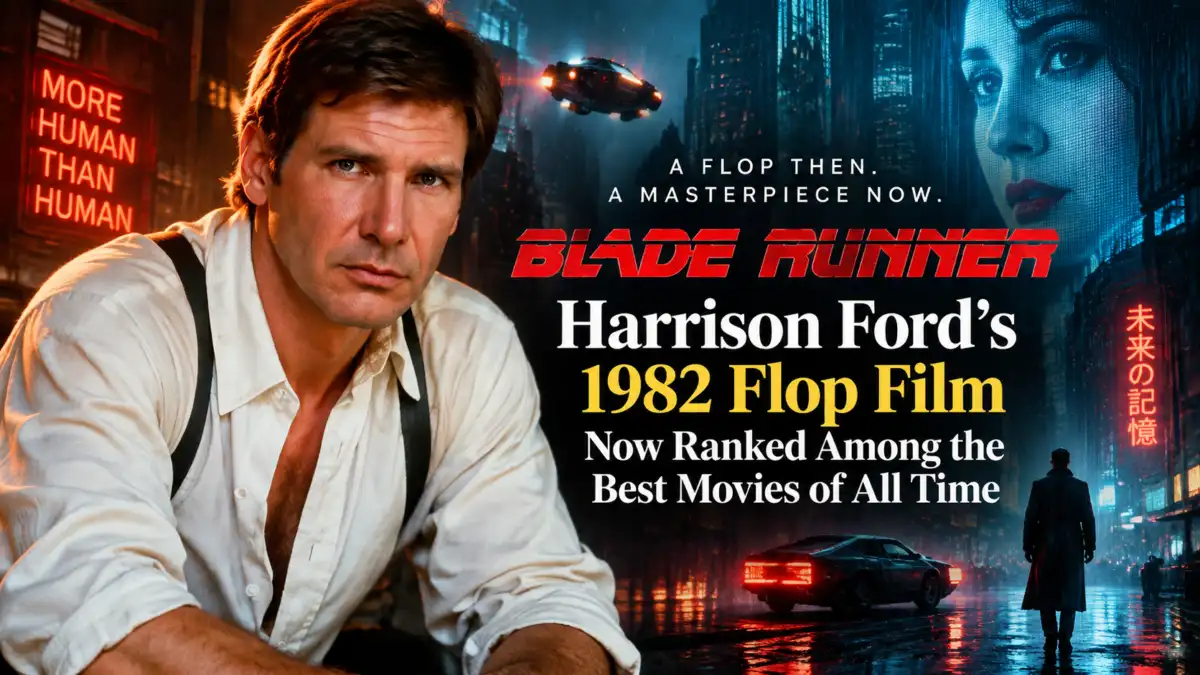
Harrison Ford’s 1982 Box Office Failure Became One of the Greatest Films Ever Made
Some movies arrive in theaters with huge expectations and disappear almost immediately. Others fail at first, only to return years later and prove that audiences simply were not ready for them.
Ridley Scott’s Blade Runner belongs to the second category.
Released in 1982, the Harrison Ford-led science-fiction film struggled when it first reached cinemas. Many viewers expected another fast-paced adventure from the actor who had just become famous as Han Solo in Star Wars and Indiana Jones in Raiders of the Lost Ark. Instead, they found a slow, atmospheric detective story filled with philosophical questions about humanity, identity, and what it truly means to be alive.
The result was a disappointing theatrical run.
Made with a budget of around $28 million, Blade Runner earned only about $6.15 million during its opening weekend and finished its original theatrical release with roughly $26 million in domestic earnings. At the time, it was viewed as a commercial disappointment, especially compared with other major films released during the same summer.
Part of the problem was timing. The film arrived shortly after Steven Spielberg’s E.T. the Extra-Terrestrial, which dominated the box office and captured mainstream audiences. While E.T. offered a warm and emotional alien story, Blade Runner presented a dark vision of the future — a rainy, neon-covered Los Angeles where humans and artificial beings struggled with questions of existence.
The movie also faced creative conflicts before reaching audiences. Studio executives worried that viewers would find the story too complicated and demanded changes, including Harrison Ford’s voice-over narration and a more straightforward ending. Those additions were later criticized by many fans and filmmakers who felt they weakened the film’s original vision.
However, Blade Runner slowly found a new audience after leaving theaters.
Through home video releases and television broadcasts during the 1980s, more viewers discovered the film’s unique style and deeper themes. Over time, critics began to appreciate Ridley Scott’s ambitious world-building, the unforgettable production design, Vangelis’ electronic score, and the performances of Harrison Ford, Rutger Hauer, and Sean Young.
The film’s reputation grew even further when Scott was able to release improved versions closer to his original vision. The 1992 Director’s Cut removed the studio-added narration, while the 2007 Final Cut refined the movie even more. These versions helped transform Blade Runner from a misunderstood release into a landmark of science-fiction cinema.
Today, the film is widely considered one of the most influential science-fiction movies ever made. Its futuristic design shaped the cyberpunk genre, influencing countless films, television shows, video games, and visual artists.
Its critical standing has also continued to rise. Blade Runner appeared on Sight & Sound’s 2022 critics’ poll of the greatest films ever made, showing how dramatically its reputation changed over the decades.
What was once considered a box office failure is now remembered as a masterpiece — a reminder that some of the most important films in history are not always recognized immediately.
Sometimes, greatness takes time.