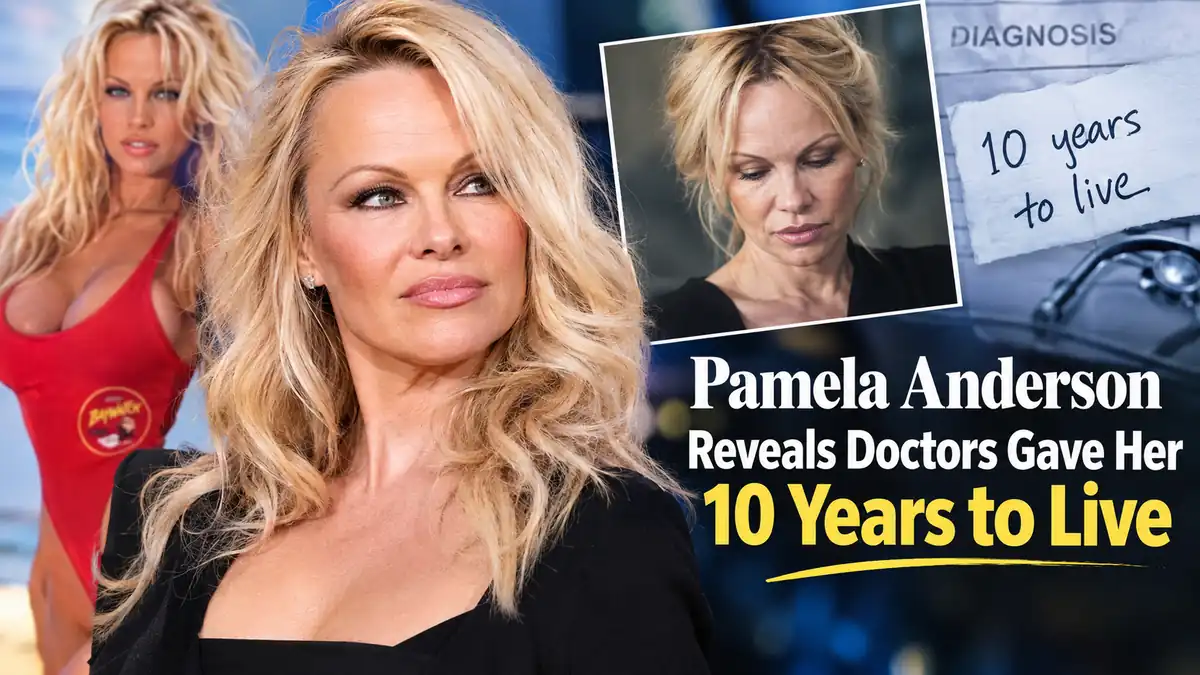
Pamela Anderson Reveals Doctors Gave Her 10 Years to Live
Pamela Anderson is opening up about one of the most frightening chapters of her life, recalling the moment doctors told her she might have only 10 years to live after being diagnosed with hepatitis C.
The actress and former Baywatch star shared the deeply personal story while accepting the Award of Courage at the 2026 amfAR Gala Venezia in Venice, Italy. During her emotional remarks, Anderson reflected on how the diagnosis changed the way she viewed her future, her career and, most importantly, her two young children.
Anderson said the diagnosis, which she received in 2002, felt like a “death sentence” at the time. According to her recollection, her doctor told her she probably had around a decade to live.
For Anderson, the news was not simply about confronting her own mortality. She was also a mother to sons Brandon and Dylan, who were young at the time. The thought of what could happen to them became one of the biggest sources of fear in her life.
“It was not fear of death,” Anderson explained during her speech. Instead, she was consumed by concerns about what her potential death would mean for her children.
A diagnosis that changed everything
Anderson has previously spoken publicly about living with hepatitis C, including the circumstances surrounding her infection. She has said that she contracted the virus after sharing a tattoo needle with her former husband, rocker Tommy Lee.
The couple were married from 1995 to 1998 and share two sons.
When Anderson received her diagnosis, hepatitis C was a far more difficult disease to treat than it is today. The medical landscape has changed dramatically since then, with newer antiviral treatments eventually making the infection curable for many patients.
But Anderson’s experience came during a period when the diagnosis carried enormous uncertainty.
She now says that the news affected many of the decisions she made afterward.
“I’m sure that colored and corrupted my decisions,” she said while reflecting on the experience.
The actress described the diagnosis as something that turned her life “inside out.” Rather than simply fearing death, she found herself thinking about the future she might not be there to witness.
Her sons were at the center of those fears.
From uncertainty to a cure
Anderson eventually received a life-changing second chance.
After years of living with hepatitis C, she was declared free of the virus in 2015 following treatment. At the time, she described the development as an extraordinary turning point after years of uncertainty.
Earlier reports from that period noted that Anderson underwent a 12-week course of antiviral treatment and was subsequently told she had been cured.
The treatment represented a dramatic change from the prognosis she had received years earlier.
Yet Anderson’s recent comments make clear that surviving the disease did not mean the experience simply disappeared from her life.
The physical illness eventually became manageable, but the emotional impact remained.
The lasting weight of shame
During her Venice speech, Anderson spoke candidly about the psychological consequences of her diagnosis.
She said feelings of shame and guilt continued to follow her even after she was cured. For Anderson, the emotional burden became intertwined with other difficult experiences from her past.
She compared that feeling to the trauma she has described from childhood, saying the sense of being damaged became something she carried internally.
Her comments reveal that surviving a serious illness can involve more than overcoming the medical condition itself. The fear, stigma and uncertainty surrounding a diagnosis can remain long after the immediate health crisis has passed.
For Anderson, the experience became part of a much larger personal journey.
But she emphasized that she no longer sees herself through the lens of victimhood.
Read More : Marvel Studios Disney+ Experiment Marks MCU’s Next Move
“I’m a victor”
Perhaps the strongest message in Anderson’s speech was her refusal to define herself by what happened to her.
“I’m not a victim, I’m a victor,” she told the audience.
She described herself as stronger and more capable than she had ever imagined and rejected the idea that she needed to occupy the role of a helpless woman waiting to be rescued.
Instead, Anderson said her creative work helped her reclaim her identity.
Acting and the arts became ways for her to process difficult experiences and turn them into something productive.
Her career has undergone a notable transformation in recent years. Once primarily known around the world as the glamorous star of Baywatch, Anderson has increasingly received attention for more dramatic work.
Her performance in The Last Showgirl earned significant critical praise and led to a Golden Globe nomination in 2025.
That recognition represented another chapter in an already complicated career.
A different chapter for Pamela Anderson
Anderson’s recent career has demonstrated that she is interested in moving beyond the public image that defined much of her early fame.
Her work has increasingly focused on acting, storytelling and creative projects that allow her to present different sides of herself.
At the Venice event, she connected that artistic evolution with her personal survival.
Rather than allowing painful experiences to define her, she said she has used her work as a way to express her truth.
That perspective gives new context to her recent career resurgence.
The actress is also continuing to develop new projects. Among them is a television adaptation connected to her 1996 film Barb Wire. Anderson and her sons are attached to the project as producers, bringing her professional and family worlds together in an unusual way.
A message about courage
Anderson’s appearance at the amfAR Gala was especially meaningful because she was being honored for courage.
The organization, which works to support HIV/AIDS research and related causes, presented Anderson with its Award of Courage during the Venice event.
Her story of hepatitis C naturally carried additional significance in that setting.
But her speech was not simply a story about surviving a disease.
It was also about confronting fear, rebuilding confidence and refusing to let a diagnosis become the final word on someone’s life.
Medical science ultimately changed Anderson’s prognosis. What once seemed like a potentially fatal diagnosis became a condition she could overcome with advances in treatment.
Her story illustrates just how dramatically medical treatment can evolve over the course of a person’s lifetime.
Looking back without looking defeated
Nearly two decades after learning that she might have only 10 years to live, Anderson is still working, creating and redefining herself.
The contrast between the prognosis she remembers and her life today is striking.
At the time, she was thinking about how her children might grow up without her. Today, Brandon and Dylan are adults, and Anderson continues to build projects alongside them.
That passage of time has given her a perspective that would have been difficult to imagine when she first received the diagnosis.
Her story is therefore not simply one of illness.
It is a story about uncertainty, motherhood, medical progress, stigma, resilience and reinvention.
Anderson’s comments also highlight how a diagnosis can shape a person’s decisions even when the disease itself eventually disappears.
The emotional scars can remain.
A life beyond the prognosis
When Anderson looks back on the period now, she does not appear interested in portraying herself as someone who narrowly escaped a predetermined fate.
Instead, she speaks about courage and personal agency.
Her message is ultimately one of choosing to move forward despite experiences that once seemed overwhelming.
She has survived a diagnosis that once filled her with fear, watched medical science transform the outlook for hepatitis C, and continued developing a career decades after becoming a household name.
Her recent success has also allowed audiences to see her in a different light.
The woman once associated primarily with a famous television swimsuit has become an actress willing to discuss vulnerability, aging, trauma, illness and reinvention publicly.
At the amfAR Gala, Anderson summed up that evolution with a message about courage.
She suggested that courage can expand a person’s life, while fear can make it smaller.
For someone who was once told she might have only 10 years left, the statement carries particular weight.
Anderson ultimately got something the prognosis did not promise her: time.
She used that time to raise her children, continue working, pursue new creative opportunities and reshape the public narrative surrounding her.
Today, she is looking back at the diagnosis not as the end of her story, but as one of the experiences that helped shape the person she became.
Her journey from a frightening hepatitis C diagnosis to a cure and a renewed creative career is a reminder that medical predictions are not always the final chapter.
For Anderson, the story continued—and she is still writing it.